Thermal Expansion and Contraction of Wood-Plastic Composite Flooring: The Real Cost of 3 Installation Mistakes
Mar 17, 2026
In the outdoor architectural and decorative industry, nothing adds more value to a home than a perfectly installed deck. However, as seasons change and temperatures fluctuate, even the sturdiest-looking outdoor wood-plastic composite flooring can fail completely due to a seemingly minor installation detail—the provision of expansion gaps. As a manufacturer with years of experience in the WPC industry, we have witnessed far too many catastrophic consequences resulting from a disregard for the principles of thermal expansion and contraction. Today, through three real-life case studies, we will delve into how errors in leaving expansion gaps have cost customers dearly, and provide valuable installation guidance for contractors and homeowners.
Case 1: Arizona Pool Deck—Widespread Warping Caused by Summer Expansion
In the summer of 2023, a high-end residential project in Phoenix, Arizona, experienced unprecedented deck failure. The project utilized approximately 150 square meters of composite decking, installed in the spring when temperatures were around 25°C. However, when summer temperatures soared above 45°C, the entire deck surface experienced severe warping and deformation. Multiple planks pressed against one another, causing the interlocking joints to break; in some areas, the deck even buckled upward by more than 5 centimeters, rendering it completely unusable.
The root cause was that the installation team failed to allow sufficient expansion joints based on the material’s coefficient of thermal expansion. The thermal expansion coefficient of WPC material is approximately 0.00006/°C, meaning that a temperature difference of 20°C results in approximately 7.2 millimeters of expansion per 6 meters of board length. In this project, the continuous flooring length exceeded 12 meters, yet less than 3 millimeters of gap was left at each end—far insufficient to absorb the stress caused by thermal expansion. Ultimately, the client was forced to remove the entire floor and reinstall it, resulting in direct losses exceeding $18,000—not to mention project delays and reputational damage. This case clearly demonstrates the importance of professional WPC flooring installation.
Case 2: Toronto, Canada Courtyard—Excessive Gaps Caused by Winter Contraction
In contrast to the Arizona case, a residential project in Toronto, Canada, encountered issues caused by winter contraction. The project was installed during the summer heat, with gaps of only 2 mm left between the planks. However, when winter temperatures dropped to -20°C, the flooring material contracted significantly, causing the gaps between planks to widen to nearly 15 mm. Such wide gaps not only compromised aesthetics but also created a safety hazard—a homeowner’s child got their foot stuck in a gap while playing, resulting in a sprain.
This case highlights an often-overlooked fact: WPC materials not only expand in heat but also contract in cold. During installation, the local annual temperature range must be comprehensively considered, rather than relying solely on the temperature at the time of installation. In temperate and cold regions, the recommended installation gap should be between 5 and 8 millimeters, and should be appropriately increased as the installation length grows. Additionally, a minimum expansion gap of 10 millimeters must be left between the flooring and fixed structures such as walls and columns, and covered with specialized edge trim to ensure both aesthetics and safety.
Case Study 3: Australian Beachfront Villa—The Double Whammy of Humidity and Temperature Fluctuations
A seaside villa project on Australia’s Gold Coast faced even more complex challenges. Located in a marine environment characterized by high humidity and high salinity, the site also experiences significant seasonal temperature fluctuations. Although the installation team provided expansion gaps for temperature changes, they completely overlooked the impact of humidity fluctuations on WPC materials. While WPC flooring has a much lower water absorption rate than natural wood, it still undergoes dimensional changes of approximately 0.5%–1% under prolonged high-humidity conditions.
More seriously, the project utilized a hollow-core flooring system but failed to establish appropriate spans between joist support points as required by specifications. Under the combined effects of temperature and humidity, the flooring underwent uneven deformation, resulting in a wavy undulation on the surface, and the fixing clips in some areas fractured due to fatigue from repeated stress. Repairing this project required not only replacing all the flooring but also readjusting the joist structure, with the total cost amounting to nearly three times that of the initial installation. This once again demonstrates that the installation of outdoor WPC flooring must strictly adhere to the manufacturer’s technical specifications and cannot be arbitrarily adjusted based on experience.
Key Principles and Best Practices for Scientific Expansion Joint Planning
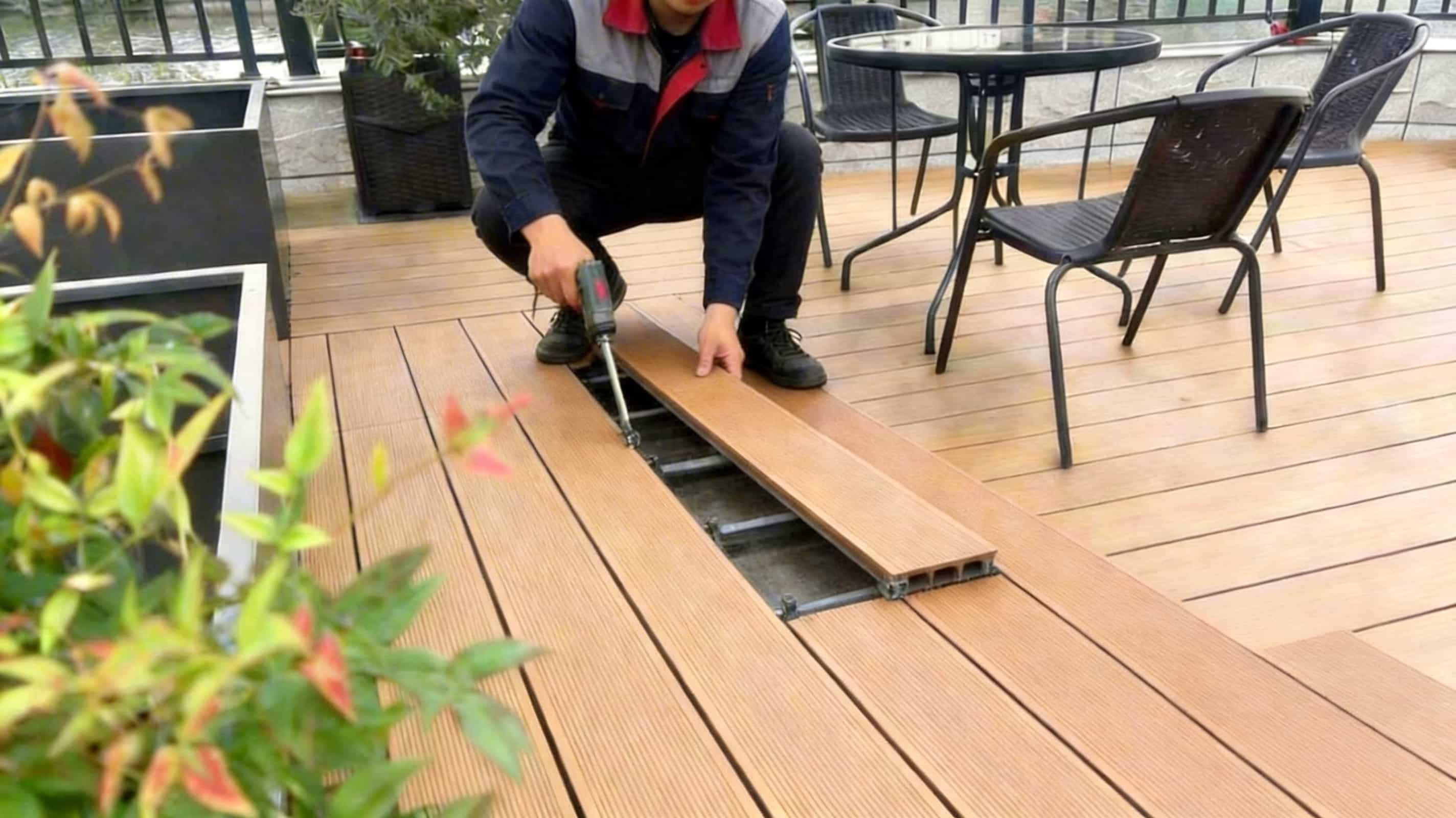
Based on the above case, we have summarized the core principles for expansion joint planning in WPC flooring installation. First, the minimum expansion gap must be calculated based on the material’s coefficient of linear expansion and local extreme temperature differences, using the formula: Expansion Gap (mm) = Length (m) × Temperature Difference (°C) × Coefficient of Expansion × 1000. Second, continuous installation lengths should not exceed 6 meters; expansion joints must be installed beyond this length. Third, a perimeter gap of at least 10 millimeters must be maintained between the flooring and any fixed structures. Fourth, choosing the right installation season is also crucial; installing during periods of average annual temperatures helps minimize the risk of extreme expansion or contraction.
Finally, we strongly recommend that contractors carefully read the manufacturer’s installation guidelines and undergo professional technical training before installation. High-quality WPC flooring installation services are not only critical to the success of your project but also directly impact your business reputation and customer satisfaction. As a responsible WPC manufacturer in China, we provide our customers with detailed technical support and installation training to ensure that every plank of flooring stands the test of time. Remember, proper installation and gap allowance are not costs, but rather the best investment in your project’s quality and your customers’ trust. In the highly competitive market of outdoor architectural decoration, details determine success or failure, and scientific installation standards are the key to distinguishing professionals from amateurs.
Read More






 IPv6 network supported